Career Guide
Best States for Game Wardens 2026
By WardenTools Research Team · Last updated 2026-06
The "best" state for a game warden career depends on what you optimize for: raw pay, job availability, cost of living, or outdoor lifestyle. This guide ranks states using BLS OEWS May 2023 salary data (SOC 33-3031) cross-referenced with employment counts and cost-of-living context. California leads on raw pay ($89,020 mean), Florida leads on job count (700 officers), and South Dakota leads on job concentration (6.31× the national average). Use these rankings to target your job search strategically.
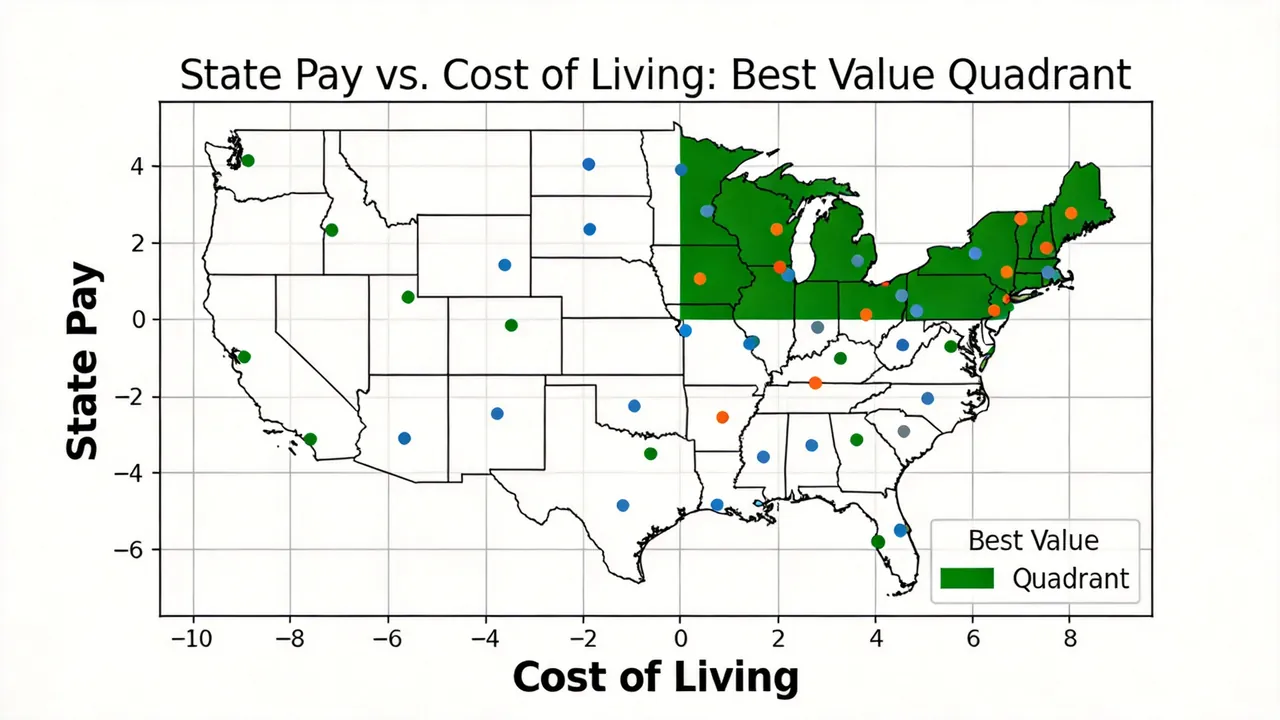
Rankings compiled by the WardenTools Research Team from BLS OEWS May 2023 data. Cost-of-living adjustments use BEA Regional Price Parities. This is informational — verify current openings with state agencies.
How We Ranked the Best States
Game warden career quality is not just about the highest salary — a $60,000 salary goes much further in Mississippi than in California. We weighted three factors:
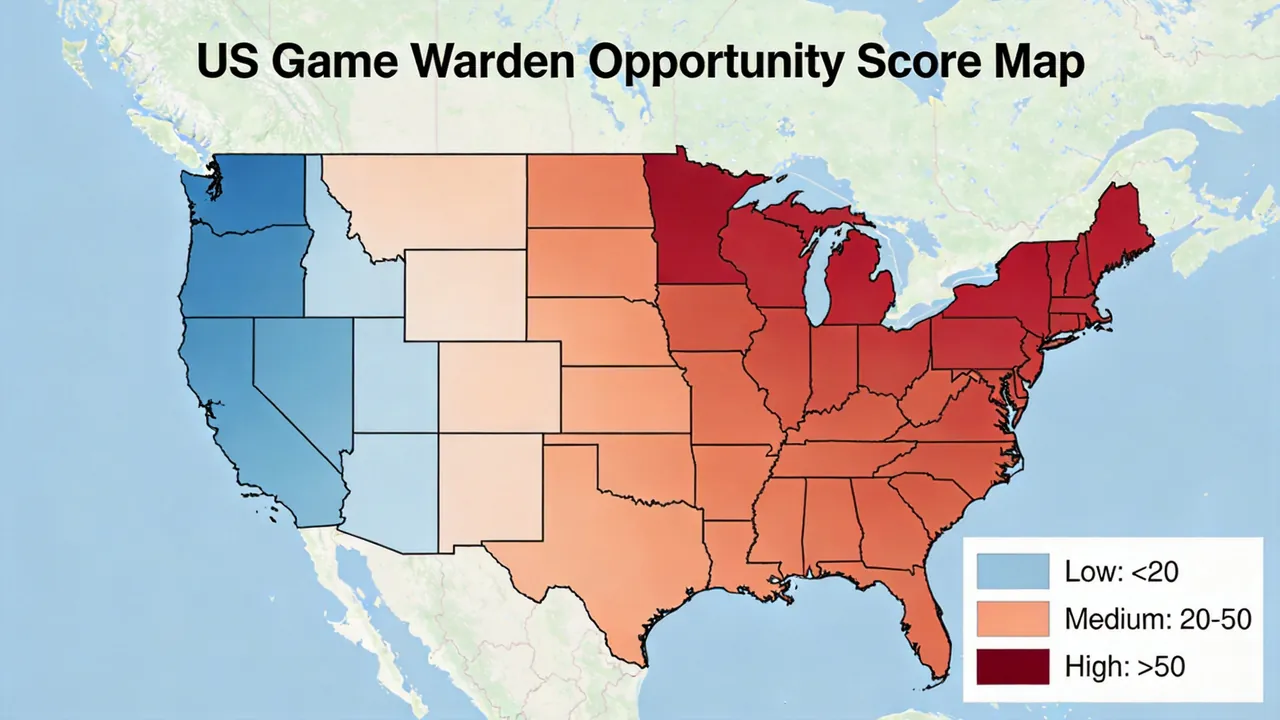
- Mean annual salary (BLS OEWS May 2023) — 50% weight. Raw pay matters for career earnings.
- Job availability (BLS employment count + location quotient) — 30% weight. More jobs = more hiring opportunities.
- Cost-of-living adjustment (BEA Regional Price Parities) — 20% weight. Adjusts pay for real purchasing power.
The result is a balanced view: high-pay states rank well but are penalized if their cost of living erodes the salary; high-job states rank well even at moderate pay; and high-concentration states (where the career is culturally established) get a job-availability boost.
Top 5 States by Raw Pay
If maximizing salary is your priority, these five states lead the nation in mean annual wage for fish and game wardens (BLS OEWS May 2023):
| Rank | State | Mean annual | Nat'l median delta | COL index |
|---|---|---|---|---|
| 1 | California | $89,020 | +$28,640 | High (110+) |
| 2 | Minnesota | $88,280 | +$27,900 | Moderate (96) |
| 3 | Washington | $82,320 | +$21,940 | High (108) |
| 4 | New York | $76,060 | +$15,680 | High (111) |
| 5 | North Dakota | $75,720 | +$15,340 | Low (93) |
The cost-of-living insight: California's $89,020 looks dominant, but its cost-of-living index above 110 means real purchasing power is lower than the headline suggests. Minnesota ($88,280 at COL 96) and North Dakota ($75,720 at COL 93) offer the strongest pay-to-cost-of-living ratios — a Minnesota warden's salary buys substantially more than a California warden's. North Dakota's combination of above-median pay and below-average cost of living makes it a sleeper pick for maximizing real income.
Explore these states: California · Minnesota · Washington · New York · North Dakota
Top 5 States by Job Availability
If your priority is getting hired, job count and concentration matter more than top pay. These five states employ the most game wardens (BLS May 2023):
| Rank | State | Employment | Location quotient |
|---|---|---|---|
| 1 | Florida | 700 | 1.03 |
| 2 | New York | 390 | 0.59 |
| 3 | Tennessee | 370 | 2.74 |
| 4 | California | 280 | 0.17 |
| 5 | Arizona | 260 | 1.01 |
The concentration insight: The location quotient (LQ) measures how concentrated game-warden jobs are relative to the national average — an LQ above 1 means the career is more established there. Tennessee's LQ of 2.74 means game warden jobs are nearly 3× more concentrated than the national average, reflecting the state's strong outdoor-recreation culture. Florida leads in raw count (700) but has an LQ near 1.0 and the lowest mean pay ($31,010) among major states.
Best balance: New York combines high employment (390) with strong pay ($76,060) — the only state in the top 5 on both metrics.
Best States Adjusted for Cost of Living
Adjusting pay for cost of living (using BEA Regional Price Parities) reshuffles the rankings. States where game-warden pay is high relative to local costs offer the best real income:
- North Dakota — $75,720 mean at COL index 93 = strongest real income per dollar
- Minnesota — $88,280 at COL 96 = excellent pay-to-cost ratio
- Maine — $64,640 at COL 102 = solid pay, moderate cost, high job concentration (LQ 5.85)
- Montana — $64,110 at COL 96 = good pay, low cost, high concentration (LQ 3.94)
- South Dakota — $56,660 at COL 92 = highest job concentration in the nation (LQ 6.31)
These states may not top the raw-pay list, but a warden's salary buys more house, goods, and services there. For candidates prioritizing lifestyle and financial stability over headline salary, the Upper Midwest and Northern Plains are standout regions.
Best States for Outdoor Lifestyle
For many aspiring wardens, the appeal of the career is the outdoor work environment. These states combine viable game-warden opportunities with exceptional outdoor-recreation quality:
- Montana — Vast public lands, big-game country, high job concentration (LQ 3.94), $64,110 mean pay
- Maine — North Woods wilderness, oldest warden service in the US (est. 1880), LQ 5.85, $64,640 mean pay
- Minnesota — 10,000 lakes, strong pay ($88,280), 140 officers, excellent fisheries enforcement
- Tennessee — Diverse terrain from Appalachia to Mississippi Delta, 370 officers, strong hiring pipeline
- South Dakota — Highest job concentration in the nation (LQ 6.31), Black Hills and prairie ecosystems
These states reward wardens who value wilderness immersion. The tradeoff is often rural duty stations and distance from major metro amenities — worth weighing against the lifestyle appeal.
States to Approach With Caution
A few states combine low pay with high cost of living, making them less attractive on a pure career-economics basis. This is not a judgment of the work itself — only an economic observation:
- Florida — Highest job count (700) but lowest mean pay ($31,010) among major states; cost of living in South Florida is elevated. Best for candidates prioritizing job availability over pay.
- Connecticut, Rhode Island, Massachusetts — Northeast states with high cost of living where game-warden pay does not always keep pace. Federal positions or specialized roles may offer better economics here.
These states still offer rewarding careers — especially for candidates with local ties or lifestyle preferences. The economic caution is about pay-to-cost ratio, not job quality.
Frequently Asked Questions
Which state pays game wardens the most? California at $89,020 mean annual wage (BLS May 2023). However, when adjusted for cost of living, Minnesota ($88,280) and North Dakota ($75,720) offer stronger real income.
Which state has the most game warden jobs? Florida with 700 officers (BLS May 2023). New York (390), Tennessee (370), California (280), and Arizona (260) round out the top 5.
Where is it easiest to get hired as a game warden? States with high job concentration (location quotient) tend to hire more regularly. South Dakota (LQ 6.31), Maine (LQ 5.85), and Tennessee (LQ 2.74) have the strongest per-capita game-warden presence, indicating established career pipelines.
Is it worth moving states to become a game warden? Often yes, if your home state has few openings or low pay. States like New York and California run academies only every few years, so timing a move to an academy cycle can be strategic. Many states have residency requirements — check before relocating.
Do federal game warden jobs pay more than state jobs? Often yes in low-wage states, but not always in high-wage states. Federal USFWS officers are paid on the GS scale (GS-7 to GS-12, roughly $49,000–$108,000 in 2024). In California ($89,020 mean), state pay exceeds most federal bands.
Sources
- U.S. Bureau of Labor Statistics, OEWS May 2023, Fish and Game Wardens (SOC 33-3031): https://www.bls.gov/oes/2023/may/oes333031.htm
- BLS OEWS state wage map: https://www.bls.gov/oes/2023/may/333031sw.htm
- Bureau of Economic Analysis, Regional Price Parities: https://www.bea.gov/data/prices-inflation/regional-price-parities-state-and-metro-area
- BLS copyright/attribution policy: https://www.bls.gov/bls/copyright.htm
Last updated June 2026. Disclaimer: Rankings are derived from public BLS and BEA data for informational purposes. Actual hiring availability, pay, and cost of living vary and change over time. Verify current openings and salary with your target state wildlife agency.