Career Guide
How to Become a Game Warden in 2026: 5-Step Career Guide
By WardenTools Research Team · Last updated 2026-06
Becoming a game warden is one of the most competitive paths in law enforcement. The U.S. Bureau of Labor Statistics (BLS) reports just 6,290 fish and game wardens employed nationwide (OEWS May 2023), meaning open positions are scarce and hiring standards are high. This guide walks through the five steps every aspiring warden must complete — from meeting baseline requirements to earning a sworn commission — with state-specific variations drawn from official state wildlife agency career pages. The full timeline from application to commissioned officer typically runs 12 to 24 months.
Written by the WardenTools Research Team. Requirements compiled from state wildlife agency career pages; salary data from BLS OEWS May 2023. This is career information — not professional counseling. Verify all current requirements with your state wildlife agency before applying.
Step 1: Meet the Baseline Requirements
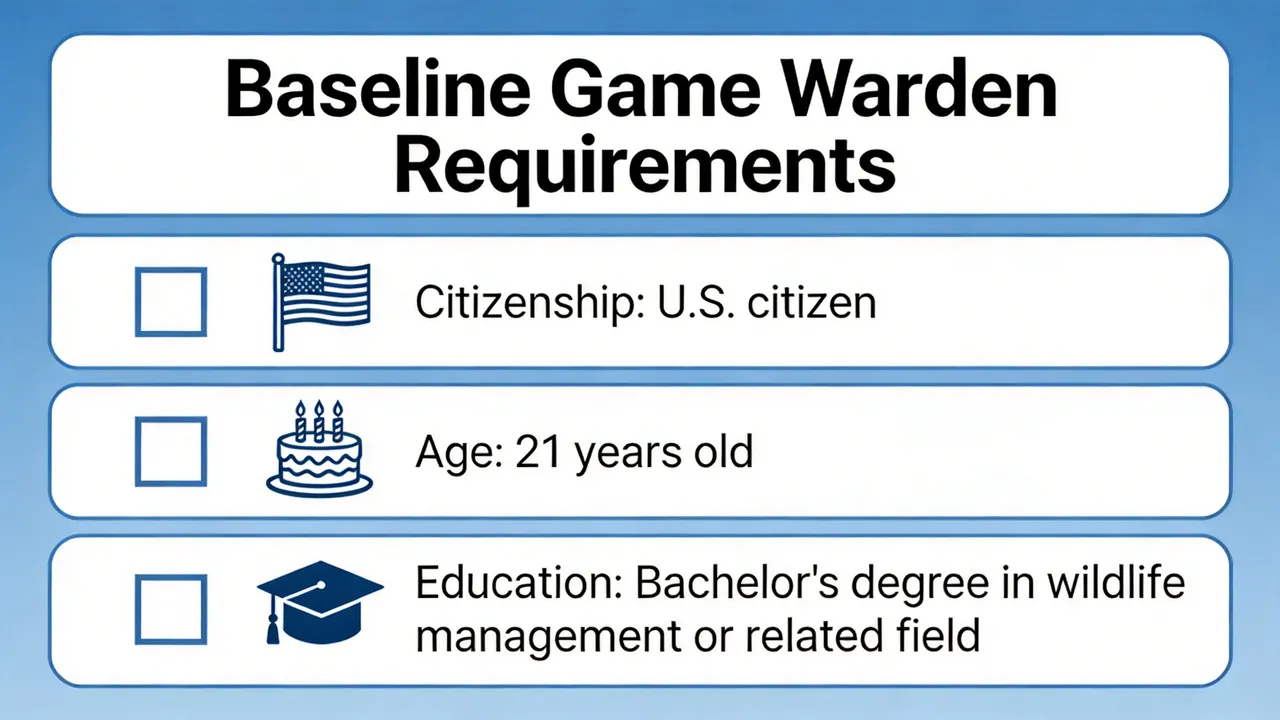
Before applying, confirm you meet the non-negotiable baseline that virtually every state wildlife agency enforces. These standards exist because game wardens work alone, armed, in remote areas — often making arrest and use-of-force decisions without immediate backup. The most common baseline requirements are:
- U.S. citizenship — Required in all 50 states and for federal positions.
- Minimum age — Most commonly 21, but California accepts applicants at 18, Florida at 19, and Vermont at 18, provided education standards are met.
- Clean criminal record — Felony convictions disqualify; many states also disqualify for certain misdemeanors (domestic violence, DUI within 5 years).
- Valid driver's license — A clean driving record is typically required; some states impose point thresholds.
- High school diploma or GED — The minimum education floor in every state, though most agencies strongly prefer or require college credits.
A key early decision is which state to target, because requirements diverge sharply from here. Texas Parks and Wildlife and the Missouri Department of Conservation both require a four-year bachelor's degree, while states like Florida, Louisiana, and Alabama accept a high school diploma plus academy training. Review your target state's wildlife agency career page — we link all 51 (50 states + DC) on our state directory.
Next: Once you confirm the baseline, plan the education or experience path.
Step 2: Complete Education or Qualifying Experience
Education is where state requirements diverge most. The table below summarizes the three tiers that cover nearly all states:
| Tier | Requirement | Example states |
|---|---|---|
| Bachelor's degree | 4-year degree in any field (natural science preferred) | Texas, Missouri |
| Associate-level (60 credits) | 60 college semester units | California |
| High school + experience | HS diploma + 2 years military or LE experience | Alabama, Iowa, North Carolina |
Even where a degree is not required, a degree in criminal justice, wildlife biology, or natural-resource management substantially strengthens your application. Federal game warden positions (U.S. Fish and Wildlife Service) require a bachelor's degree with coursework in biology or a related field, placing them firmly in the bachelor's tier. For working students, accredited online programs in criminal justice and wildlife management are widely available — see our game warden degree guide for specific programs.
Beyond formal education, relevant experience counts heavily. Military service, prior law enforcement, volunteer work with state wildlife agencies, and seasonal conservation jobs all improve competitiveness. The hiring process is rigorous enough that any demonstrable commitment to outdoor skills — boating, hunting, fishing, wilderness survival — can differentiate applicants.
Next: Once education or experience is in place, apply and sit for the entrance exams.
Step 3: Apply and Pass the Entrance Exams
The application process for game warden positions is a multi-stage civil-service gauntlet that typically takes 3 to 6 months from job posting to conditional offer. Most state wildlife agencies post openings on their agency career pages and on state civil-service portals. Expect the following stages, in rough order:
- Written examination — A civil-service or agency-specific exam testing reading comprehension, writing, logic, and wildlife-law knowledge.
- Physical agility test — Events typically include a 1.5-mile run, push-ups, sit-ups, a drag (simulating victim rescue), and a swim test. California CDFW requires a 500-yard continuous swim.
- Oral interview — A panel interview with wildlife-agency officers covering judgment, ethics, and situational responses.
- Background investigation — A thorough check covering criminal history, credit, employment, references, and a polygraph in many states.
- Psychological evaluation and medical exam — Standard for sworn-officer roles.
- Conditional offer of employment — Issued pending academy graduation.
Competition is intense because openings are scarce relative to applicants. New York State DEC, for example, employs 390 environmental conservation officers statewide (BLS May 2023), with new academies opening only every few years. Preparation matters: candidates who study the specific agency's wildlife laws and practice the physical test events in advance have a measurable edge.
Next: With a conditional offer, you enter the academy.
Step 4: Graduate from the Academy
Academy training is the longest single phase — typically 6 to 7 months residential — and combines general peace-officer certification with agency-specific wildlife training. The curriculum covers criminal law, constitutional law, firearms, defensive tactics, emergency vehicle operation, wildlife identification, boat operation, search-and-rescue, and report writing. Most states split training into two segments: a state-certified basic police academy followed by an agency-specific wildlife academy.
Major academies and their durations:
- California CDFW Academy — 20-week basic + 8-week agency-specific (28 weeks total)
- New York Basic School for ECOs — 26-week residential at the Pulaski academy
- Texas Game Warden Training Academy — 17-week residential at TPWD Austin
- Pennsylvania Ross Leffler School of Conservation — the oldest game-warden academy in the U.S. (founded 1932)
- Federal FLETC — U.S. Fish and Wildlife Service officers train at the Federal Law Enforcement Training Center in Glynco, GA
Academy graduation confers state peace-officer certification, but you are not yet a fully commissioned warden. Compare academy timelines for all states in our game warden academy guide.
Next: The final phase is supervised field training.
Step 5: Complete Field Training and Earn Commission
After academy graduation, new wardens enter a field-training program — typically 3 to 6 months — during which they patrol with an experienced training officer before receiving independent duty assignment and full sworn commission. During field training, the new warden's reports and enforcement actions are reviewed, and performance is evaluated against standardized benchmarks. Successful completion results in assignment to a patrol district (often rural and remote) and full law-enforcement authority within the wildlife agency's jurisdiction.
The commissioning moment — receiving the badge and sworn oath — marks the transition from trainee to full game warden. From this point, career progression follows state civil-service ladders: senior warden, sergeant, lieutenant, and into supervisory or specialized roles (investigations, K-9, marine enforcement, aviation). Pay increases with rank; the BLS 90th-percentile wage of $86,880 reflects senior and supervisory officers.
Related: Once commissioned, wardens often pursue specialized training — see our academy guide for advanced certifications.
Frequently Asked Questions
How competitive is it to become a game warden? Very. With only 6,290 positions nationwide (BLS May 2023), openings are scarce. New York's DEC, for example, runs an academy only every 2–4 years. Strong education, relevant experience, and physical fitness preparation are essential.
Can I become a game warden with a felony on my record? No. All states disqualify felony convictions, and many also disqualify specific misdemeanors (domestic violence, recent DUI). Federal positions have equally strict standards.
Do game wardens need to know how to swim? Yes, in most states. California requires a 500-yard continuous swim; many states include a swim test in the physical agility exam because wardens patrol waterways and conduct water-based rescues.
Is military service helpful? Yes. Many states accept 2 years of military service in lieu of college credits, and veterans' preference often applies in civil-service scoring. See your state agency's career page for specifics.
What's the youngest age to become a game warden? Most states require age 21, but California (18), Florida (19), and Vermont (18) accept younger applicants who meet education standards. The federal minimum is 21 (or 20 with college credits for some roles).
Sources
- U.S. Bureau of Labor Statistics, OEWS May 2023, Fish and Game Wardens (SOC 33-3031): https://www.bls.gov/oes/2023/may/oes333031.htm
- California Department of Fish and Wildlife, Law Enforcement recruitment: https://wildlife.ca.gov/Enforcement
- New York State DEC, Division of Law Enforcement: https://www.dec.ny.gov
- Texas Parks and Wildlife, Game Warden careers: https://tpwd.texas.gov
- State wildlife agency career pages — full directory on our state directory
Last updated June 2026. Disclaimer: This is career information compiled from public government sources, not professional counseling or legal advice. Game warden requirements change; always verify current standards with your state wildlife agency's official career page before applying.