Resource
Game Warden Requirements 2026
By WardenTools Research Team · Last updated 2026-06
Game wardens must meet stricter requirements than most law enforcement roles because they work alone, armed, in remote areas with limited backup. This guide compiles the baseline requirements common to all 50 states plus the variations that matter: minimum age (18 to 21), education (high school to bachelor's), physical fitness standards, background-check disqualifiers, and residency rules. Requirements are drawn from official state wildlife agency career pages and the federal U.S. Fish and Wildlife Service.

Compiled by the WardenTools Research Team from state wildlife agency career pages. Requirements change — always verify current standards with your state agency before applying.
Universal Baseline Requirements
Every state wildlife agency and the federal U.S. Fish and Wildlife Service enforce a common baseline. Failing any one of these disqualifies an applicant regardless of state:
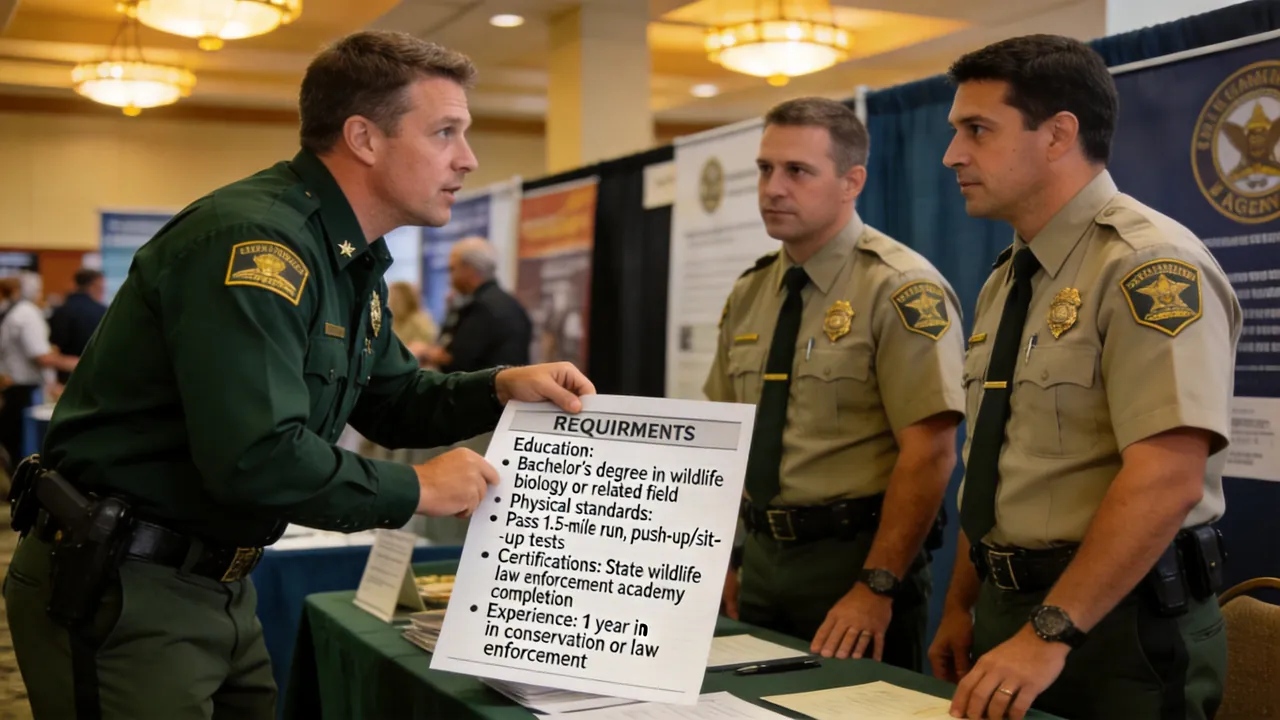
- U.S. citizenship — Required in all 50 states and for all federal positions. Permanent residents are not eligible for sworn officer roles.
- High school diploma or GED — The minimum education floor in every state. Most agencies strongly prefer or require college credits beyond this.
- Valid driver's license — A clean driving record is typically required; most states impose a point threshold (e.g., no more than 4 points in the prior 3 years).
- Clean criminal background — Felony convictions disqualify everywhere. Most states disqualify for domestic-violence misdemeanors, recent DUIs (within 3–5 years), and certain drug offenses.
- Minimum age — Most commonly 21, but ranges from 18 to 21 depending on state (see below).
- Medical and psychological fitness — A medical exam and psychological evaluation are standard for all sworn-officer roles.
These six requirements are non-negotiable. Where states differ is in age, education, and experience — covered next.
Find your state: Each state's exact requirements are detailed on its dedicated page at /state/[state]/ — for example, California requirements or Texas requirements.
Minimum Age Requirements by State
The minimum age to apply as a game warden ranges from 18 to 21. Most states set the floor at 21, aligning with federal firearms possession law for sworn officers, but three states accept younger applicants who meet education standards:
| Minimum age | States |
|---|---|
| 18 | California, Vermont |
| 19 | Florida |
| 20 | New York, Maryland |
| 21 | Most states (Texas, Pennsylvania, Michigan, Ohio, Georgia, etc.) |
Younger applicants must typically meet higher education standards. California, for example, accepts applicants at 18 only if they have completed 60 college semester units. Federal U.S. Fish and Wildlife Service positions require age 21 (or 20 with qualifying college credits).
Education Requirements: The Three Tiers
Education is where state requirements diverge most sharply. Nearly all states fall into one of three tiers:
| Tier | Requirement | Example states |
|---|---|---|
| Bachelor's degree | 4-year degree in any field (natural-science preferred) | Texas, Missouri |
| Associate-level (60 credits) | 60 college semester units | California |
| HS diploma + experience | High school diploma + 2 years military or LE experience | Alabama, Iowa, North Carolina, Virginia |
Why the variation? States with smaller warden forces and high applicant volume (Texas, Missouri) can demand a bachelor's. States with large forces and harder-to-fill rural vacancies (Florida, Louisiana) accept a high school diploma plus experience to widen the applicant pool. The federal U.S. Fish and Wildlife Service requires a bachelor's degree with biology coursework.
Even where not required, a degree in criminal justice, wildlife biology, or natural-resource management substantially strengthens your application. See our game warden degree guide for accredited programs, including online options for working students.
Physical Fitness Standards
Game wardens work in physically demanding outdoor environments — hiking remote terrain, operating boats, conducting water rescues, and occasionally pursuing suspects on foot. Most states require a physical agility test as part of the hiring process, with events that commonly include:
- 1.5-mile run — Typical completion standard: 14–16 minutes (varies by state and age)
- Push-ups — Often 25–35 reps in one minute
- Sit-ups — Often 30–40 reps in one minute
- Dummy drag — Dragging a 150–175 lb dummy 50 feet (simulating victim rescue)
- Swim test — A continuous swim (e.g., California requires 500 yards; states typically require 100–300 yards)
- Obstacle course — Some states include a tactical agility course
California's swim standard is among the strictest — a 500-yard continuous swim in under 14 minutes — reflecting the state's extensive coastline and waterway enforcement. Failing the physical test is a common reason applicants are eliminated; candidates should train specifically for the listed events 3–6 months before testing.
Background Check & Disqualifiers
Because game wardens carry firearms and have arrest authority, the background investigation is thorough — typically lasting 2 to 4 months and covering criminal history, credit, employment verification, reference interviews, and often a polygraph. Common automatic disqualifiers include:
- Any felony conviction (all states)
- Domestic-violence misdemeanor conviction (federal Lautenberg Amendment applies)
- DUI/DWI within the past 3–5 years (varies by state)
- Illegal drug use within a specified look-back period (often 3 years for marijuana, longer for other drugs)
- Dishonorable military discharge
- Pattern of serious traffic violations
- False statements on the application (dishonesty is treated more harshly than the underlying conduct)
Honesty during the background investigation is critical. Many agencies will work with applicants who disclose past issues transparently but will reject anyone caught misrepresenting their history. The polygraph, where used, focuses on verifying disclosed information.
Residency & Other State-Specific Requirements
Several states impose additional beyond the universal baseline:
- Residency — Some states require residency within the state before hire or within a set period after commissioning (e.g., within 6 months). Others accept out-of-state applicants.
- Firearms qualification — All states require firearms proficiency; some require applicants to bring prior firearms certification.
- Boating certification — States with extensive waterways (Florida, Minnesota, Michigan) may require or prefer boating-safety certification.
- Foreign-language skills — Border states (Texas, Arizona, New Mexico) may prefer bilingual applicants.
- Hunting/fishing experience — Not required, but strongly preferred and often assessed in the oral interview.
Verify with your state: These附加 requirements change frequently. Check your state's wildlife agency career page — full directory on our state directory.
Frequently Asked Questions
Can you become a game warden with a GED? Yes. All states accept a GED in lieu of a high school diploma. However, most agencies prefer or require additional college credits beyond the GED.
Will a misdemeanor disqualify me? It depends on the misdemeanor. Domestic-violence misdemeanors disqualify everywhere (federal law). DUI within the past 3–5 years often disqualifies. Minor misdemeanors (e.g., old traffic offenses) typically do not, but must be disclosed honestly.
Do you need a college degree to be a game warden? Not in every state. Texas and Missouri require a bachelor's; California requires 60 college credits; many southeastern and midwestern states accept a high school diploma plus military or LE experience. A degree strengthens your application everywhere.
Is there a maximum age to become a game warden? Most states have no statutory maximum, but federal positions and some states cap entry at 37 (due to retirement provisions). Prior sworn-officer experience can waive the federal age cap.
Do game wardens need hunting or fishing experience? It is not a formal requirement, but it is strongly preferred and often assessed in the oral interview. Demonstrable outdoor skills — boating, hunting, fishing, wilderness navigation — differentiate applicants.
Sources
- U.S. Fish and Wildlife Service, Office of Law Enforcement careers: https://www.fws.gov/le
- California Department of Fish and Wildlife, Wildlife Officer requirements: https://wildlife.ca.gov/Enforcement
- Texas Parks and Wildlife, Game Warden careers: https://tpwd.texas.gov/careers
- State wildlife agency career pages — full directory on our state directory
- BLS OEWS May 2023, Fish and Game Wardens (SOC 33-3031): https://www.bls.gov/oes/2023/may/oes333031.htm
Last updated June 2026. Disclaimer: Requirements are compiled from public state-agency sources and change over time. This is not legal or career-counseling advice. Verify all current standards with your state wildlife agency before applying.